How Drone Technology Is Revolutionising Farming in Africa
From the fertile lands of Nigeria to the highlands of Rwanda and the arid zones of Kenya, Drone Technology, a quiet yet profound transformation, is making waves. The dusty fields that once relied on outdated techniques and drudgery are now infused with intelligence from drone technology. The Unmanned Aerial Vehicles (UAVs) commonly known as drones, are evolving to become essential tools in the fight for food security, crop improvement, sustainable productivity, sustainable land use and nature management.
Drone Technology in Africa
Africa as a continent presents a continent where agriculture accounts for nearly 60% of the source of livelihood directly or indirectly and over 30% of GDP in many of the African countries. Climate change, soil degradation, scarcity and unaccountable distribution of rainfall patterns alongside the continuous rise in population growth have placed immense pressure on African farmers, of which most are peasants.
Meanwhile, poor traditional farm tools and trial and error approach are no longer reliable to meet the continent's food production needs due to the population growth. However, with the continuous emergence of smart agriculture initiatives using technologies, especially drone-based precision agriculture, it presents not just as a solution but a revolution in Africa agriculture.
The Emergence of Smart Farming in African Contexts
Before gaining much ground and accessibility, precision agriculture was seen as a luxury for large-scale commercial farms in developed nations only. But as the cost of drone hardware drops and software becomes more accessible with young African farmers diving into the machine learning space, Africa is now experiencing a democratisation of these technologies. Government, agritech investors and even small startups are now introducing farmers to precision farming technologies, and this is reshaping their source of livelihood.
An important component of this transformation is crop monitoring drones. A device equipped with thermal and multispectral sensors, these drones provide detailed visualizations of crop health, irrigation needs, and pest outbreaks. Due to its smart invention, Farmers now use data often in real time to make decisions rather than just using intuition or visual observation.
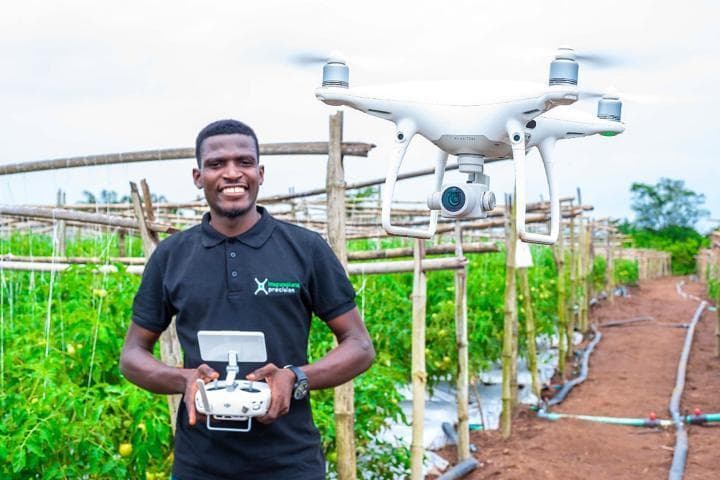
In Africa, companies like Integrated Aerial Precision, based in Nigeria, are leading this charge. Their drone services have also been tailored to benefit both large-scale and smallholder farmers. The services, which include drone crop scouting, agricultural drone spraying, and geospatial mapping, have enabled precision agriculture to flourish in even the most remote areas of the country. Their recent work with rice farmers in Kebbi State and trainings through the Precision Field Academy, for example, helped identify nitrogen deficiencies across fields, optimising fertiliser use and improving yields by over 38%. Precision Field Academy Drone Training in Kebbi state, Nigeria
Farming with Intelligence: The Role of Data
The power of drones in agriculture is magnified when combined with AI in agriculture, IoT in farming, and agricultural data analytics. These technologies form an interconnected ecosystem where drones gather high-resolution imagery and sensors collect environmental data, all analysed by AI systems to guide actions.
For instance, the Senegalese startup Tolbi utilises drones and machine learning algorithms to measure soil moisture and recommend automated irrigation systems. In regions where water scarcity is critical, this has helped reduce water usage by as much as 60% without impacting productivity. Similarly, Morocco-based SOWIT integrates aerial drone data with satellite imagery to enable remote sensing in agriculture and yield mapping technology, giving farmers predictive insights that were once unimaginable.
These advancements mean African farmers no longer need to react after problems occur; they can anticipate them, intervene early, and plan for the future.
Drones Take the Sky: Agricultural Spraying and Seeding
One of the most tangible impacts of drones is in agricultural spraying. Traditionally, pesticide and fertiliser application has been labour-intensive, inefficient, and sometimes hazardous. Today, agricultural drones for spraying, including DJI agricultural drones, allow for pinpoint application of chemicals, reducing costs and environmental damage.
A maize cooperative in Western Kenya, in partnership with Apollo Agriculture, began using agricultural sprayer drones in 2023. Within two growing seasons, pesticide use dropped by 50% while crop yields rose by 25%. The drones’ ability to hover and target specific rows or plants made the difference not only saving money but also reducing run-off into local water systems.
More remarkably, drone-based agriculture spraying systems now support variable rate technology, which adjusts the quantity of chemicals based on real-time data about plant health. With these drones, African farmers can avoid over-application, prevent soil degradation, and comply with emerging sustainability regulations.
Additionally, companies like Agridrone South Africa have introduced precision seeding technology using drones, drastically improving planting efficiency in conservation agriculture zones. Seeding that would take two workers a full day is now accomplished in less than an hour, significantly reducing labour costs and operational bottlenecks.
Agricultural Surveying and Mapping for Smarter Land Use
Africa’s agricultural expansion often suffers from poor land planning and outdated maps. Drone technology is correcting this imbalance. Farmers, governments, and NGOS now use drone surveying for farms and GPS guidance for farming to understand terrain, optimise field design, and resolve land disputes.
In Zambia’s Southern Province, a land reform program funded by USAID used UAV drone agriculture tools to map over 20,000 hectares. The result was more secure land tenure, clearer property lines, and better alignment of infrastructure like irrigation channels and access roads. Similar initiatives in Ethiopia and Ghana have used drones to assess soil health using soil analysis drones, guiding investments in regenerative agriculture practices.
These drone-based insights also support precision livestock farming, especially in arid zones where grazing lands are sparse. Monitoring pasture conditions from the sky allows for smarter rotational grazing and reduced overgrazing, protecting both the livestock and the environment.
Regulatory Frameworks and Cost Considerations
Despite the benefits, challenges remain. Drone regulations for agricultural use vary widely across Africa. Some nations, like Rwanda and South Africa, have well-established frameworks for UAV licensing, while others lag. As the technology spreads, harmonising airspace laws and creating clear pathways for drone training and certification will be critical.
Affordability also remains a concern. While the cost of drones has dropped significantly basic agriculture drones can now be acquired for under $1,000 ongoing maintenance, software subscriptions, and training represent barriers. To tackle this, some agribusinesses are offering cost-effective drone solutions for farmers via service models. For example, Precision Agriculture for Development (PAD) partners with local cooperatives to provide drone services on a per-acre basis, allowing smallholder farmers to access high-tech tools without upfront investments.
Farm Management Software and Integration at Scale
The full potential of drones is realized when they’re integrated with farm management software and decision support systems. Tools like FieldMargin, Agri-Tech Africa, and Agremo provide platforms where drone imagery, satellite imagery for agriculture, and sensor data can be analyzed in unison.
Farmers using these platforms can monitor moisture levels, track pest infestations, and receive actionable recommendations on precision fertiliser application and harvesting schedules. Some systems even offer weather forecasting powered by AI, helping farmers anticipate rain or heatwaves, an invaluable feature for those battling increasingly erratic climate conditions.
In Malawi, a digital agriculture initiative combined drone data with historical yield records and weather monitoring for agriculture to optimise planting schedules. Farmers participating in the program reported a 28% increase in maize yields compared to control groups.
Return on Investment: Precision Agriculture Pays Off
Is this investment worth it for African farmers? The answer is a resounding yes.
According to an evaluation by the International Food Policy Research Institute (IFPRI), farmers who adopted drone-based solutions in East Africa saw a 3:1 ROI within two growing seasons. Input costs dropped due to better targeting of fertilisers and pesticides, while productivity increased because of timely interventions and precision planting.
Even smallholder farms, when supported by government or private sector programs, showed impressive gains. A Tanzanian pilot project using agricultural drone sprayers reported a 70% reduction in spraying time and a 20% improvement in crop quality.
These findings bolster the case for scaled-up investment in digital agriculture. Precision agriculture ROI for farmers is no longer a theory, it’s a demonstrated outcome.
African Innovators Leading the Way
While global drone brands like DJI dominate the hardware space, African innovators are shaping how these tools are deployed locally. From Integrated Aerial Precision in Nigeria to SOWIT in Morocco and Tolbi in Senegal, homegrown startups are bridging the technology gap with region-specific knowledge.
These companies provide services ranging from crop analytics and drone rentals to agronomic advice tailored to local languages and crop varieties. They often partner with NGOS, research institutes, and banks to increase adoption, bringing the future of farming within reach for even the most resource-constrained communities.
Toward Resilient & Data-Driven Farming: How Drone Technology Is Revolutionising Farming in Africa
As the world looks toward 2030, the ultimate goal for African agriculture is one of efficiency, connectivity, and sustainability. The use of drones is developing from just ordinary flying gadgets; they are now becoming the nodes in a vast network of agriculture. Whether it’s usage through precision farming, thermal imaging for crops, soil monitoring or real-time data integration, the future is taking shape above the permanent tree crop’s top and arable crop fields of the continent. We are looking forward to the time when the introduced agricultural robotics and farm automation systems will be enhancing what drone technology has started. Thus, it is safe to say that: “For Africa, the agricultural revolution is airborne and there’s no turning back.”
📞 Ready to transform your farm? Contact us today at 08085070112 or visit www.iaprecision.com and take the first step toward smarter agriculture with our expert drone solutions.